
- Project: Solar-powered artificial electro/photosynthesis of CO2 for greenhouse gas (GHG) reduction from flaring onshore gas terminals
- Reference no.: EENG/0062
- Sponsored by: Petronas Research Sdn. Bhd. (PRSB)
- Status: Principal Investigator
- Project leader: Prof. Dr. Ong Wee Jun
- Amount: RM 1,279,775.00
- Project duration: 1/11/2024 – 31/10/2026 (on-going)
- Project: Scale Up of Photocatalytic Hydrogen Production and Storage for Fuel Cells and Energy Storage Devices
- Reference no.: SPO/2024/S.24008
- Sponsored by: MOSTI Malaysia and NanoMalaysia Berhad
- Status: Principal Investigator
- Project leader: Prof. Dr. Ong Wee Jun
- Co-investigator: Dr. Tan Ji Siang
- Amount: RM 1,249,000.00
- Project duration: 1/11/2024 – 30/4/2026 (on-going)
- Project: d–f Orbital Regulation in Rare-Earth-Doped Layered Double Hydroxides for Paired Electrocatalytic CO2 Conversion and Waste Plastic Valorization
- Reference no.: SRICSPYF-ZY2025037 and IENG/0090
- Sponsored by: Ministry of Education (MOE) China
- Status: Principal Investigator
- Project leader: Prof. Dr. Ong Wee Jun
- Amount: RMB 15 million (around MYR 8.7 million)
- Project duration: 1/1/2026 – 31/12/2030 (on-going)
- Project: Modulating Zinc and Sulfur Vacancies Density in Zinc Indium Sulfide: Unravelling Charge Dynamics and Reaction Mechanisms for Photoredox Dual Reaction of CO2 Reduction and Benzyl Alcohol Oxidation
- Reference no.: FRGS/1/2024/TK08/XMU/02/1
- Sponsored by: Ministry of Higher Education (MOHE) Malaysia
- Status: Principal Investigator
- Project leader: Prof. Dr. Ong Wee Jun
- Co-investigator: Prof. Abdul Rahman bin Mohamed, Assoc. Prof. Haw Choon Yian, Dr. Tan Ji Siang, Assoc. Prof. Herma Dina binti Setiabudi, Dr. Lee Hing Wah
- Amount: RM 175,900.00
- Project duration: 1/8/2024 – 31/7/2027 (on-going)
- Project: Advanced Cu-Based Layered Double Hydroxide Electrocatalysts Driving Scalable CO2-to-C2 Conversion Coupled with Selective Biomass-Derived Alcohol Oxidation
- Reference no.: XMUMRF/2025-C15/IENG/0080
- Sponsored by: Xiamen University Malaysia
- Status: Principal Investigator
- Project leader: Prof. Dr. Ong Wee Jun
- Co-investigator: Dr. Tan Ji Siang, Dr. Ng Boon Junn, Associate Professor Dr. Haw Choon Yian, Mr. Yap Feng Ming, Ms. Loh Jian Yiing
- Amount: RM 60,000.00 (3 years)
- Project duration: 1/1/2025 – 31/12/2027 (on-going)
- Project: Production of Graphene & Green Hydrogen Supply Chain from Biomethane
- Reference no.: SRF-APP BICEP Project 4 (NPDO/2022/S.22015/C0)
- Sponsored by: Ministry of Science, Technology and Innovation (MOSTI) Malaysia
- Status: Principal Investigator
- Project leader: Prof. Dr. Ong Wee Jun
- Amount: RM 10,500,000.00 (3.5-year grant project)
- Project duration: 1/7/2022 – 30/6/2026 (on-going)
Postgraduate Students under Primary Supervision (Xiamen University Malaysia, XMUM)
- Project title: Low-dimensional 2D visible-light responsive photocatalyst for multifunctional applications
- Research output: Nano Research, Materials Today Nano, Small Structures, InfoMat, Applied Materials Today, etc.
- Project title: Layered double hydroxides-based electrocatalysts for CO2 conversion and alcohol oxidation
- Research output: Nanoscale, Journal of Materials Science & Technology
- Project title: Self-supported carbon-based substrates for electrocatalytic CO2 conversion and alcohol oxidation
- Research output: Nano Research Energy, Nano Research
- Project title: Production of graphene and green hydrogen supply chain from biomethane using microwave plasma technology
- Project title: Metal sulfide photocatalysts for simultaneous photocatalytic plastic waste valorization and CO2 conversion
- Project title: Copper-based electrocatalysts for CO2 reduction to C2+ products
Full Citation: Wee-Jun Ong, Meei Mei Gui, Siang-Piao Chai and Abdul Rahman Mohamed (2013). Direct growth of carbon nanotubes on Ni/TiO2 as next generation catalysts for photoreduction of CO2 to methane by water under visible light irradiation. RSC Advances, 3, 4505-4509. Link
Notes:
Highly Cited Paper in January–December 2015
Full Citation: Wee-Jun Ong, Lling-Lling Tan, Siang-Piao Chai, Siek-Ting Yong and Abdul Rahman Mohamed (2014). Highly reactive {001} facets of TiO2-based composites: Synthesis, formation mechanism and characterizations. Nanoscale, 6, 1946-2008. Link
Notes:
Highly Cited Paper (2015-2024)
Top 20 Most Accessed Nanoscale Articles in 2014
Top 10% Highly Cited Nanoscale Articles in 2016
Full Citation: Wee-Jun Ong, Lling-Lling Tan, Siang-Piao Chai, Siek-Ting Yong and Abdul Rahman Mohamed (2014). Facet-dependent photocatalytic properties of TiO2-based composites for energy conversion and environmental remediation. ChemSusChem, 7, 690-719. Link
Notes:
Highly Cited Paper (2015-2024)
Highlighted in ChemInform, 2014, 45, 23
Full Citation: Wee-Jun Ong, Lling-Lling Tan, Siang-Piao Chai, Siek-Ting Yong and Abdul Rahman Mohamed (2014). Self-assembly of nitrogen-doped TiO2 with exposed {001} facets on the graphene scaffold as photo-active hybrid nanostructures for reduction of carbon dioxide to methane. Nano Research, 7, 1528-1547. Link
Notes:
Hot Paper (Jan-Feb 2015)
Highly Cited Paper (2015-2024)
Top Paper Award 2016
Full Citation: Wee-Jun Ong, Jia-Jun Yeong, Lling-Lling Tan, Boon Tong Goh, Siek-Ting Yong and Siang-Piao Chai (2014). Synergistic effect of graphene as a co-catalyst for enhanced daylight-induced photocatalytic activity of Zn0.5Cd0.5S synthesized via an improved one-pot co-precipitation-hydrothermal strategy. RSC Advances, 4, 59676-59685. Link
Full Citation: Wee-Jun Ong, Seen-Yee Voon, Lling-Lling Tan, Boon Tong Goh, Siek-Ting Yong and Siang-Piao Chai (2014). Enhanced daylight-induced photocatalytic activity of solvent exfoliated graphene (SEG)/ZnO hybrid nanocomposites towards degradation of Reactive Black 5. Industrial & Engineering Chemistry Research, 53, 17333-17344. Link
Inventors: Wee-Jun Ong, Joel Jie Foo, Tan Ji Siang and Shalini a/p Muniandy
Patent Agency: MyIPO
Patent No.: PI2022006574
Status: Filed on 22 November 2022
Inventors: Wee-Jun Ong, Tan Ji Siang
Patent Agency: MyIPO
Patent No.: PI2024003031
Status: Filed on 24 May 2024
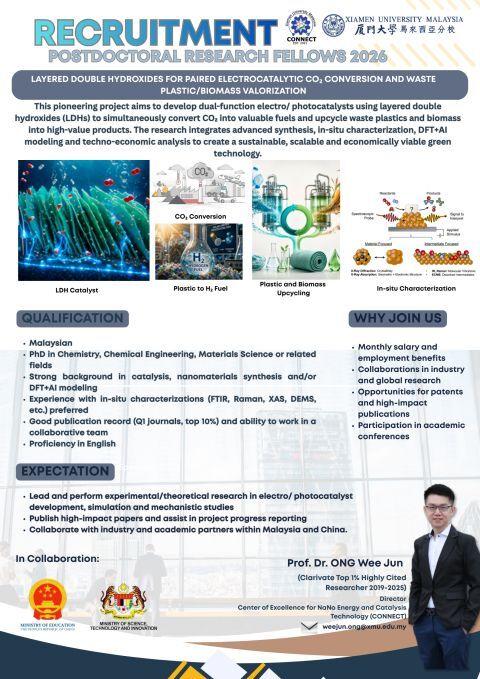
Join Our Team at Center of Excellence for NaNo Energy & Catalysis Technology (CONNECT), Xiamen University Malaysia.
In conjunction with the recent award of a major research grant from the Ministry of Education, we are pleased to announce multiple research opportunities under the primary supervision of Prof. Dr. Wee-Jun Ong at the CONNECT, Xiamen University Malaysia (XMUM), for the Fall 2026 & Spring 2027 intakes.
We are seeking highly motivated researchers to join our cutting-edge research project:
🌱 Tunable Metal-Based Electrocatalysts and Photocatalysts for Paired CO₂ Conversion and Waste Plastic/Biomass Valorization.
In collaboration with the industry in Malaysia, this project aims to simultaneously:
♻️ Convert CO₂ into valuable chemicals
♻️ Upcycle waste plastics/biomass into high-value products
♻️ Convert wastewater nitrate into ammonia as a sustainable hydrogen carrier
♻️ Advance sustainable energy & circular economy technologies
Our research integrates:
🔹 Advanced nanomaterials synthesis
🔹 In-situ/operando characterization
🔹 Density functional theory & AI-assisted modelling
🔹 Techno-economic analysis
🔬 Open Research Positions at CONNECT:
(1) Postdoctoral Research Fellows cum Executive (Multiple positions)
📅 Application Deadline: 30 September 2026 (open until filled)
(2) Postgraduate Research Students (Master’s & PhD | Multiple positions)
📅 Application Deadline: 30 September 2026 (open until filled)
Why Join CONNECT?
🌍 Work on globally impactful clean energy research
🧪 Access to state-of-the-art analytical facilities from CONNECT (spanning over 600+ m² across six specialized labs at XMUM), Xiamen University (China), and Korea University
🤝 Collaborate with leading researchers & international partners
📚 Publish in high-impact journals & present at international conferences
💡 Excellent opportunities for career development in academia & industry
We welcome only Malaysian applicants with backgrounds in Chemistry, Chemical Engineering, Materials Science, Nanotechnology, Catalysis, Computational Chemistry and other disciplines.
If you're passionate about sustainable energy, nanocatalysis, CO₂ utilization, & advanced materials, we would love to hear from you!
📧 For applications, please contact:
Prof. Dr. Wee-Jun Ong (王伟俊)(Director of CONNECT)
📩 weejun.ong@xmu.edu.my
Kindly review the recruitment posters carefully for detailed eligibility criteria. Submit your CV, cover letter, certificates, transcripts, research statements, and other documents to Prof. Ong. Only shortlisted candidates will be contacted for an interview.
Please feel free to share this opportunity with colleagues, students & researchers who may be interested.
Research and Postgraduate Centre,Xiamen University Malaysia
New Energy Science & Engineering
Chemical Engineering, Xiamen University Malaysia
#Postdoctoral #PhD #Masters #ResearchOpportunity #Electrocatalysis #Photocatalysis #CircularEconomy

Catalyzing Nanotechnology and Energy Excellence at XMUM
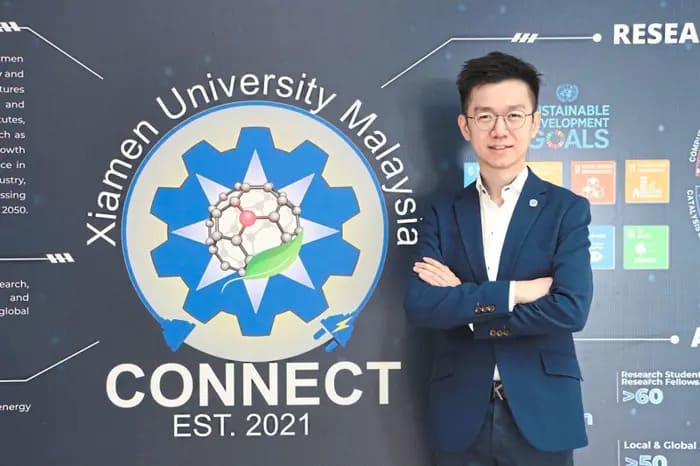
Center of Excellence (CoE) for NaNo Energy and Catalysis Technology (CONNECT) is an inaugural CoE at Xiamen University Malaysia (XMUM). This CoE was established on 10 October 2021 inspired by the Belt and Road Initiative in celebration of the 100th anniversary of Xiamen University (China) and the 5th year anniversary of XMUM.
CONNECT targets to advance nanotechnology and materials research in Malaysia and beyond. Focusing on interdisciplinary fields, CONNECT nurtures talent and understanding in advanced nanomaterials, catalysis, energy, and computational nanotechnology. By fostering collaboration between research institutes, organizations, and industries, CONNECT targets to contribute to the Sustainable Development Goals such as affordable and clean energy and climate action. In line with Malaysia's economic growth vision, it centers on renewable energy and a green economy. Striving for excellence in nanoscience, CONNECT serves as a bridge between academia, agency, and industry, aiming for a circular economy. Through its initiatives, CONNECT seeks to tackle pressing global challenges while propelling Malaysia towards achieving carbon neutrality by 2050.

Vision
We inspire a synergistic, interdisciplinary, and collaborative approach to research, fostering high-impact publications, intellectual property advancements, and exceptional professional services through partnerships with local and global organizations, research institutes, and industrial players.

Mission
Contributing societal benefits through continual research and innovation in energy sustainability via eight primary NANO disciplines:
- 2D nanomaterials
- Nanostructured materials
- Photo- and electro-catalysis
- Plasma technology
- Sustainable energy production
- Energy harvesting, conversion, and storage
- Batteries and supercapacitors
- Computational nanotechnology
Core Values - ASPIRE
Aspiration
To persevere in the landscape of science and technology toward making an impact on a wider community.
Synergy & Community
To develop a collaborative environment across all disciples, including academic and industry.
Professionalism
To uphold the integrity and persistence towards lifelong learning by continuously seeking self-improvement.
Innovation
To strive towards novel and original solutions in-face of the dynamic pace of research.
Responsibility
To ensure that our work is conducted ethically in the course of research.
Excellence
To be a motivated and resilient scholar who demonstrates commitment and passion toward our pursuit of excellence.
Research Horizons

Nanomaterials Engineering
- To uncover the intrinsic properties of nanomaterials of various dimensions and morphologies.
- To develop facile synthesis strategies for high-performance nanomaterials for energy and environmental science applications.
- To mass produce the nanostructured materials in the large-scale synthesis with facile and cost-effective synthesis.
- To produce nanomaterial system with speed and cost-effectiveness via additive manufacturing in the proliferation of the Industry 4.0 processes.
- Discovery of high-throughput energy materials
- Artificial photosynthesis, solar steam generation
- Artificial electrocatalysis
- Diverse energy materials – hydrogel, aerogel, beads, etc.
Catalysis & Solar-to-Fuel Conversion
- To construct and create a fundamental framework for the dynamic reaction mechanisms in solar-to-chemical generation.
- To strive for real-time accurate depiction of experimental reaction conditions through the use of in-situ and operando analysis.
- To translate the laboratory-scale energy efficiency findings to technological readiness.
- Nanocatalysts for sustainable fuels production
- Smart catalyst design and modification
- Mechanistic study of catalytic reaction
- Catalytic production of fuels and valuable organics from waste
- Multiscale phototype development and field-test integration
- Transition from batch-to-continuous production mode
- High-throughput prototype design and rigorous testing
- Benchmarking standards to target on carbon neutrality


Energy Storage
- To evaluate the potential of different types of beyond Li-ion batteries (e.g. metal-sulfur, metal-air batteries, etc.).
- To integrate with solar energy to design a novel solar energy storage system.
- To develop a prototype energy storage device with excellent stability, durability and storage capacity as a potential candidate for real-world usage.
- Advanced energy storage technologies
- Higher energy density capacity and stability
- Lower energy charging and discharging process
- Target condition 20% gravimetric capacity
Computational Nanotechnology
- To utilize first-principles calculations to extend our fundamental knowledge of the dynamic catalytic mechanisms.
- To utilize machine learning (ML), big data analysis and artificial intelligence (AI) for material screening or discovery of innovative material combinations toward ground-breaking research in materials science
- Nanocatalysts for sustainable fuels production
- Smart catalyst design and modification
- Mechanistic study of catalytic reaction
- Catalytic production of fuels and valuable organics from waste
- Multiphysics modelling simulation and mechanisms
- Mechanistic understanding of catalytic performances
- Computational chemistry for high-performance catalysts
- Artificial intelligence and machine learning of catalysts

Organization structure
Director
Permanent Members
Research Staff
Postdoctoral Research Fellow
- Dr. Noor Ashikin binti Mohamad
- Dr. Raja Rafidah binti Raja Sulaiman
- Nurul Aqilah Binti Razali