

CHAN Mieow Kee
Assistant Professor Ir. Dr.
About Me
Dr. Chan Mieow Kee is a Chemical Engineering academic and researcher whose work focuses on membrane technology, nanoparticles, sustainable materials, and environmental engineering applications. Her research interests include water and wastewater treatment, adsorption systems, and intelligent material development. She actively collaborates with industrial partners and agencies to translate research into practical engineering solutions, particularly in sustainability and environmental management. Dr. Chan has published extensively in international journals and is involved in multidisciplinary research projects integrating advanced materials, process optimisation, and sustainable engineering practices.
Professional Engineer, Board of Engineers Malaysia (BEM)
Research Interests
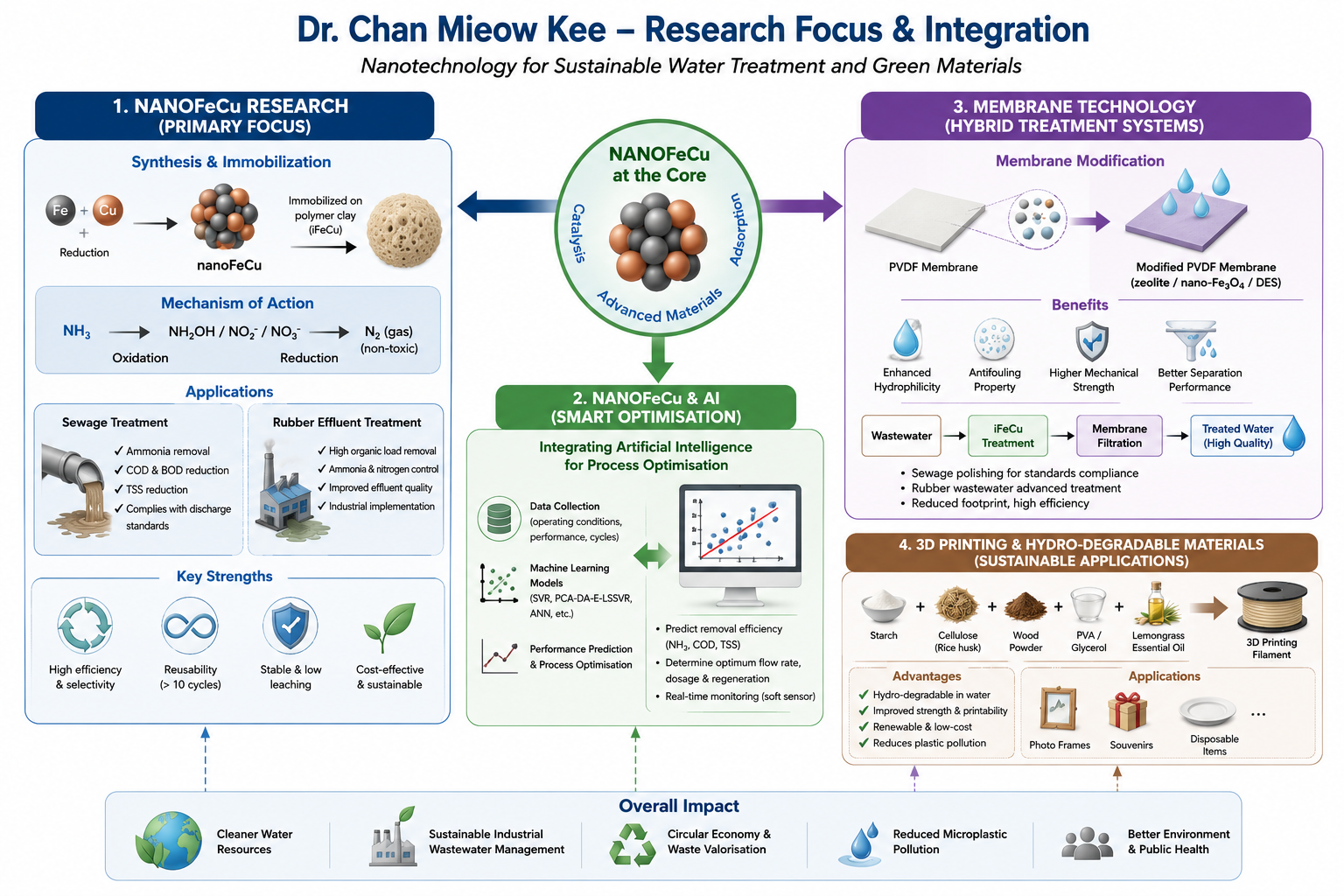
Dr. Chan Mieow Kee’s research focuses on nanotechnology, wastewater treatment, and sustainable environmental engineering applications. Her work extensively investigates the development and application of immobilized iron–copper bimetallic nanoparticles (iFeCu) for the treatment of sewage and rubber industry wastewater. The research emphasizes ammonia, COD, and suspended solids removal through advanced catalytic and adsorption processes while ensuring nanoparticle stability, reusability, and environmental safety. In parallel, she explores membrane technology and hybrid treatment systems to improve separation efficiency and wastewater polishing performance. Machine learning and soft-sensor modelling approaches are also integrated to optimise process prediction and operational efficiency. In addition, her studies extend into sustainable hydro-degradable materials and green composites derived from agricultural waste for environmental applications. Through collaborations with industries and water-related agencies, her research aims to bridge laboratory innovation with practical engineering implementation, contributing toward cleaner water resources, circular economy practices, and sustainable wastewater management solutions.
Research Project(s)
- Sustainable integration of used water filters and immobilised bimetallic iron-copper nanoparticle for rubber effluent treatment.
- Ozonation for condenser water treatment.
- Optimization of ammonia oxidation process via machine learning.
- Hydrodegradable materials for 3D printing.
Current Courses Taught
- Engineering Thermodynamics
- Principles of Chemical Engineering II
Local Grant(s)
- Sustainable integration of used water filters and immobilised bimetallic iron-copper nanoparticle for rubber effluent treatment. Aug 2024 – July 2025. Funded by Intrix Lifestyle Sdn. Bhd.
- Ozonation for condenser water treatment. December 2023 – June 2024. Funded by Medklinn International Sdn. Bhd.
- Optimization of ammonia oxidation process via machine learning. Jan 2022 – June 2024. Jointly funded by SEGi University and Curtin University Malaysia.
- Hydrodegradable materials for 3D printing. October 2020 – September 2022. Jointly funded by SEGi University and 3D Gens Sdn. Bhd.
International Grant(s)
Journal
- Chan, M. K.*, Choo, C. M., Sharani, N. A., Mohd Aris, A., Khor, B. C. (2026). Risk analysis of immobilized iron copper nanoparticle for sewage treatment. The Canadian Journal of Chemical Engineering. https://doi.org/10.1002/cjce.70170
- Hamza, A., Chan, M. K.*, Ho, K. C., King, Y. J., Subhramaniyun, P. (2025). Sustainable integration of used water filters and immobilized bimetallic iron-copper nanoparticles for rubber wastewater treatment. Separation and Purification. 379: 135039. https://doi.org/10.1016/j.seppur.2025.135039
- Cao, D. D., Chan, M. K.*, Sharani, N. A., Mohd Aris, A., Khor, B. C. (2025). Innovative approaches in sewage treatment: Optimization and evaluation of the reusability and sustainability of iFeCu nanoparticles. Separation and Purification. 369: 133011. https://doi.org/10.1016/j.seppur.2025.133011
- Guo, Y., Izni*, Chan, M. K., Quan, J.* (2025). RSM-rCCD Optimizing for paclitaxel extraction from Taxus Chinensis by natural deep eutectic solvents and studying antioxidant activity. Current Analytical Chemistry. https://www.eurekaselect.com/article/147562
- Cao, D. D., Chan, M. K.*, (2024). Enhancing chemical synthesis research with NLP: Word embeddings for chemical reagent identification—A case study on nano-FeCu. iScience. 27: 110780. https://doi.org/10.1016/j.isci.2024.110780
- Andrew, Y. T. H., Chan, M. K.*, Ong C. S., Ho, K. C. (2024). Effects of hydrogen bond donors on PVDF membrane modification using choline chloride-based deep eutectic solvents. Journal of Industrial and Engineering Chemistry. 139: 514 – 524. https://doi.org/10.1016/j.jiec.2024.05.028
- Chan, M. K., Yeo, W. S.*, Ngu, J. C. Y., Lee, P. Y., Nandong, J., Sharani, N. A., Mohd Aris, A., Khor, B. C. (2024). Enhancing sustainability in sewage treatment: A least square support vector regression-based modeling approach for optimizing regeneration conditions of iFeCu. Journal of Water Process Engineering. 64: 105694. https://doi.org/10.1016/j.jwpe.2024.105694
- Ngu, J. C. Y., Yeo, W. S.*, Chan, M. K., Nandong, J. (2024). Least square support vector regression-based modelling of ammonia oxidation using immobilized nanoFeCu. Journal of Water Process Engineering. 64: 105695. https://doi.org/10.1016/j.jwpe.2024.105695
- Hamza, A., Ho, K. C.*, Chan, M. K. (2024). Recent development of substrates for immobilization of bimetallic nanoparticles for wastewater treatment: A review. Environmental Science and Pollution Research. Springer. 31: 40873 – 40902. https://doi.org/10.1007/s11356-024-33798-6
- Chan, M. K.*, Tan, S. J., Andrew, Y. T. H., Ng, S. C., Lau, W. J. (2024). Zeolite-based poly(vinylidene fluoride) ultrafiltration membrane: Characterization and molecular weight cut-off estimation with support vector regression modeling. Membranes. 14: 91. https://doi.org/10.3390/membranes14040091
- Chan, M. K.*, Wang, C. C., Tee, Y. S., Tan, M. H., Janasekaran, S., Aziz. I, Musa, S., Ridzuan (2024). Starch/wood powder/glycerol/lemongrass essential oil composite as the hydro-degradable materials for 3D printing. Starch – Stärke. 2024:2300108. https://doi.org/10.1002/star.202300108
- Chan, M. K*., Tan, W. H., Ho, K. C., Subhramaniyun, P. (2023). The use of immobilized nanoFeCu for rubber wastewater treatment in Malaysia. Chemical Engineering Transactions. 106: 1279 – 1284. https://doi.org/10.3303/CET23106214
- Chwa L. A., Lim, M. W.*, Anzian, A., Meor Hussin, A. S., Lee, B. K. W., Chan, M. K. (2023). Effect of varying light spectrum on antioxidant production of red leaf lettuces cultivated using fish wastewater. Chemical Engineering Transactions. 106: 1027 – 1032. https://doi.org/10.3303/CET23106172
- Chan, M. K.*, Lim, K. H., Mohd Aris, A., Ho, Y. P., Khor, B. C. (2023). Flowrate impact on the performance of immobilized nanoFeCu for sewage treatment and its reusability. The Canadian Journal of Chemical Engineering. 101: 6406 – 6416. https://doi.org/10.1002/cjce.24926
- Chan, M. K.*, Kumaran, P., Thomas, X. V., Natasha, E., Tee, Y. S., Mohd Aris, A., Ho, Y. P., Khor, B. C. (2023). Embedded nanoFeCu for sewage treatment – Lab scale and pilot studies. The Canadian Journal of Chemical Engineering. 101: 3751 – 3758. https://doi.org/10.1002/cjce.24721
- Chan, M. K.*, Sham, A., Wang, C. C., Lee, P. Y., Jahani, Y., Mirbagheri, S. A. (2023). Artificial neural network model for membrane desalination: A predictive and optimization study. Computation. 11: 68. https://doi.org/10.3390/computation11030068
- Cao, D., Chan, M. K.*, Ng, S.K. (2023). Modelling and forecasting of nanoFeCu treated sewage quality using recurrent neural network (RNN). Computation. 11: 39. https://doi.org/10.3390/computation11020039
- Ho, K. C.*, Chan, M. K., Subhramaniyun, P. (2023). Treatment of rubber industry wastewater review: Recent advances and future prospects. Journal of Water Process Engineering. 52 (2023): 103559. https://doi.org/10.1016/j.jwpe.2023.103559
- Chen, Y. M., Ho, K. C.*, Chan, M. K., Teow, Y. H., Aida Isma, M.I. (2023). Optimization of antifouling properties of mixed matrix membrane synthesized via in-situ colloidal precipitation, Journal of Membrane Science and Research. 9 (2023): 557323. http://www.msrjournal.com/article_254998.html
- Lee, Z. C., Ho, K. C.*, Chan, M. K., Teow, Y. H. (2022). Effect of carbon nanomaterials concentration in nanocomposite membrane for methyl blue dye removal. Jurnal Teknologi. 84 (6): 19 – 27. https://doi.org/10.11113/jurnalteknologi.v84.18277
- Chan, M. K.*, Ooi, C. S. (2022). Reusability of nano-Fe-Fe3O4/polyvinylidene difluoride membrane for palm oil mill effluent treatment. Trends in Sciences. 19 (13): 4636. https://doi.org/10.48048/tis.2022.4636
- Chan, M. K.*, Siaw, F. L., Gunasegaran, A., Murugan, S., Radahakrishnan, R., Kumaran, S. V. N. V., Kumaran, P. (2022). Optimization of photovoltaic reflector system for indoor energy harvesting. Journal of Harbin Institute of Technology. 29 (4): 65 – 69. http://hit.alljournals.cn/jhit_cn/ch/reader/view_abstract.aspx?file_no=202102230000003&edit_id=20210223150652001&flag=2
- Tai, S. Y., Lim, L. F., Chan, M. K.*, Bullar, P. K. (2022). Adsorption isotherm study of activated fruit peels for copper removal. Journal of Harbin Institute of Technology. 29 (3): 93 – 100. http://hit.alljournals.cn/jhit_cn/ch/reader/view_abstract.aspx?file_no=20220310&flag=1
- Chan, M. K.*, Tang, T. H. (2022). The properties of starch/cellulose/polyvinyl alcohol composite as hydrodegradable film. Polymers and Polymer Composites. 30: 1 -8 https://doi.org/10.1177/09673911221100353
- Chan, M. K.*, Wang, C. C., A. A. Arbai. (2022). Development of dynamic OBE model to quantify student performance. Computer Application in Engineering Education. 1 – 14. https://doi.org/10.1002/cae.22520
- Kow, J. Y., Lim, L. F., Chan, M. K.*, Saeed, A. A. (2022). Kinetic study for the adsorption of heavy metals on zeolite. Journal of Harbin Institute of Technology. 29 (1): 70 -76. http://hit.alljournals.cn/html/jhit_cn/2022/1/20220108.html
- Tee, Y. S., Lik, H. L. N.*, Chan, M. K. (2022). Phosphorus removal and phytonutrients retention in the refining of solvent extracted palm-pressed mesocarp fiber oil. Journal of Oleo Science. 71 (2): 177 – 185. https://www.jstage.jst.go.jp/article/jos/71/2/71_ess21256/_pdf
Elgadi, A., Chan, M. K.*, Tan, Y. C. (2022). Palmitic acid – lauric acid/expanded graphite as form-stable composite phase change material for low-temperature energy storage applications. Journal of Harbin Institute of Technology. 29 (5): 41-48. http://hit.alljournals.cn/jhit_cn/ch/reader/view_abstract.aspx?file_no=20220504
Book
- Yeo, W. S., Chan, M. K.*, Bukhari, N. A. (2022). Prediction of glucose concentration hydrolysed from oil palm trunks using a PLSR-based model. Intelligent Computing and Optimization. 927 – 937. https://doi.org/10.1007/978-3-030-93247-3_88
- Mohd. Amiruddin, A. A. A., Chan, M. K.*, Ng, S.C. (2022). Development of contact angle prediction for cellulosic membrane. Intelligent Computing and Optimization. 207 – 216. https://doi.org/10.1007/978-3-030-93247-3_21
Chan, M. K.*, Wang, C. C., Tee, H. C., Bukhari, N. A. (2022). Optimisation and prediction of glucose production from oil palm trunk via simultaneous enzymatic hydrolysis. Intelligent Computing and Optimization. 55 -64. https://doi.org/10.1007/978-3-030-93247-3_6
Conference Proceeding
- Chan, M. K.*, Lim, K. W., Mohd Jais, J. L., Yeoh, T. K. K. (2023). Effect of supporting materials for nanoFeCu immobilization. AIP Conference Proceeding. 2847: 020011. https://doi.org/10.1063/5.0165315
Current Supervision (Postgraduate only)
- Name: Chen Suo
Education: Ph.D. Engineering
Project: Integrated Techno-Economic and Life Cycle Assessment of Immobilised Iron-Copper Nanoparticles for Enhanced Sewage Treatment Performance and Sustainability
Duration: May 2025 - Now
SEGi University
Completed Supervision (Postgraduate only)
- Name: Ali Hamza
Education: MSc. Engineering
Project: The use of an integrated membrane-nanoFeCu system for the treatment of wastewater.
Duration: Jan 2023 – May 2025
SEGi University - Name: Guo Ying
Education: Ph.D. Engineering
Project: Extraction and antioxidant activity of active ingredients of authentic taxus chinensis in Hubei Province
Duration: 2022 – October 2025
SEGi University - Name: Joyce Ngu Chen Yen
Education: Master of Philosophy
Project: A novel intelligent soft sensor for nanoFeCu catalysed ammonia removal process
Duration: 2022 – April 2024
Curtin University Malaysia - Name: Cao Ding Ding
Education: Ph.D. Engineering
Project: AI-driven sewage treatment using immobilised iron copper for ammonia removal
Duration: September 2021 – October 2024
SEGi University